
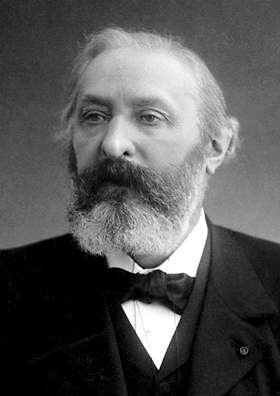
The 1901 Nobel Prize in Literature was the first awarded Nobel Prize in Literature. It was awarded to the French poet Sully Prudhomme (1839–1907) "in special recognition of his poetic composition, which gives evidence of lofty idealism, artistic perfection and a rare combination of the qualities of both heart and intellect."
Laureate
Sully Prudhomme belonged to a school of poets that wanted to write in a classic and formally elegant style. His poetry combined formal perfection with an interest in science and philosophy. According to the Swedish Academy, his elevated poetry fit in Alfred Nobel's formulation about works "in an ideal direction".
Deliberations
Nominations
Sully Prudhomme was nominated for the prize by 17 members of the Académie Française, of which Sully Prudhomme himself was a member. In total the Nobel committee received 37 nominations for 26 writers including Frédéric Mistral (five nominations) and Henryk Sienkiewicz (three nominations) who were subsequently both awarded the prize, and the only woman nominated, Malwida von Meysenburg. The first name on their list of candidates was Émile Zola, but the campaign from the Académie Française proved to be successful and the Swedish Academy chose to award Sully Prudhomme. The notable authors R. D. Blackmore, Anne Beale, Victoire Léodile Béra, Stephen Crane, Ernest Dowson, José Maria de Eça de Queiroz, Carit Etlar, Naim Frashëri, Mary Kingsley, Max Müller, Friedrich Nietzsche, Sigbjørn Obstfelder, Pyotr Lavrov, John Ruskin, Henry Sidgwick, Charles Dudley Warner, Oscar Wilde, Vladimir Solovyov and Gheorghe Dem Teodorescu all died in 1900, making them ineligible for the 1901 nominations. The nominated French theologian Louis Sabatier died months before the announcement, and authors Leopoldo Alas, Víctor Balaguer i Cirera, Walter Besant, Ada Christen, Ramón de Campoamor, Luis Mariano de Larra, Kate Greenaway, Julien Leclercq, William Cosmo Monkhouse, Frederic W. H. Myers, Johanna Spyri, Grigore Sturdza, Maurice Thompson, Vasile Alexandrescu Urechia, Brooke Foss Westcott and Charlotte Mary Yonge died in 1901 without having been nominated for the prize.
Prize decision
At the start of the deliberations, 6 writers of the 25 nominees were immediately rejected by the Nobel Committee "on account of the inferiority of their writings" and they were Julius Gersdotff, Oscar le Pin, Ferenc Kemény, Giacomo Stampa, Ossip Lourié and Malwida von Meysenbug. For the year 1901, the main candidates for the prize were the French writers Frédéric Mistral (subsequently awarded in 1904) and Sully Prudhomme. Carl David af Wirsén of the Nobel committee argued that the two poets were equally prominent, but that the French Academy's recommendation of Sully Prudhomme should be decisive in awarding him the prize. Emile Zola's candidacy was dismissed by Wirsén due to his distaste for naturalist writers.
Reactions
The Swedish Academy's decision to award Sully Prudhomme the first Nobel Prize in Literature was intensely covered by the French newspaper Le Figaro, who appeared to acknowledge the literature prize as the most interesting and important of the five Nobel prizes. On the day the prizes were awarded Le Figaro dedicated two front-page articles on Sully Prudhomme, one report on the prize itself and one interview with the poet, followed by another lengthy front-page article the next day presenting all the laureates, and a second article describing the idea of the Nobel prize. Elsewhere, particularly Swedish reactions were heavily critical and caused a domestic scandal. The choice of Sully Prudhomme was interpreted as a politeness towards the Académie Française, model to the Swedish Academy. Many believed that Lev Tolstoy should have been awarded the first Nobel Prize in literature. The Swedish author August Strindberg angrily reacted saying that Prudhomme is "hardly a poet although he writes in verse", and that it was scandalous that he was awarded the prize just because he was a member of an academy that the Swedish Academy wanted to impress. The leading representatives of the contemporary Swedish cultural elite including August Strindberg, Selma Lagerlöf, Verner von Heidenstam, Oscar Levertin, Bruno Liljefors, Anders Zorn and Albert Engström protested against the Academy and sent a letter to Tolstoy saying he was the most worthy recipient of the prize and that the Swedish Academy did not represent the majority of Swedish cultural persons. Critical reactions also came from the German newspaper Berliner Zeitung who described Prudhomme as a poet who was respected but not read. An English newspaper said that Sully Prudhomme was a second rate poet who had not achieved anything in many years. Many said Tolstoy was the superior candidate and should have been awarded the prize. The Swedish Academy defended themselves from the criticism by saying that Tolstoy had not been nominated for the prize, and could thus not be awarded.
Notes
Award ceremony speech by C.D. af Wirsén nobelprize.org
Demo article adapted from 1901 Nobel Prize in Literature on Wikipedia. Wikipedia text is available under the Creative Commons Attribution-ShareAlike 4.0 License; additional terms may apply.