Adverse selection
Economics

Adverse selection

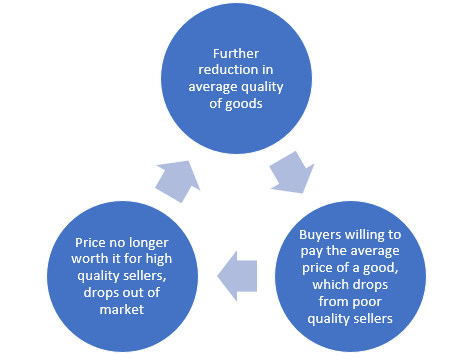
In economics, insurance, and risk management, adverse selection is a market situation where asymmetric information results in a party taking advantage of undisclosed information to benefit more from a contract or trade. In an ideal world, buyers should pay a price which reflects their willingness

Chris Chris
· · 14 min read
Economics

2015–2016 Chinese stock market turbulence

The 2015-2016 Chinese stock market turbulence began with the popping of a stock market bubble on 12 June 2015 and ended in early February 2016. A third of the value of A-shares on the Shanghai Stock Exchange was lost within one month of the event. Major aftershocks occurred around 27 July and 24

Chris Chris
· · 17 min read
Alan Greenspan
Economics

Alan Greenspan

Alan Greenspan (born March 6, 1926) is an American economist who served as the 13th chairman of the Federal Reserve from 1987 to 2006. He worked as a private adviser and provided consulting for firms through his company, Greenspan Associates LLC. First nominated to the Federal Reserve by President

Chris Chris
· · 20 min read
Economics

Agricultural economics

Agricultural economics is an applied field of economics concerned with the application of economic theory in optimizing the production and distribution of food and fiber products. Agricultural economics began as a branch of economics that specifically dealt with land usage. It focused on maximizing

Chris Chris
· · 5 min read
Economics

Adaptive market hypothesis

The adaptive market hypothesis, as proposed by Andrew Lo, is an attempt to reconcile economic theories based on the efficient market hypothesis (which implies that markets are efficient) with behavioral economics, by applying the principles of evolution to financial interactions: competition,

Chris Chris
· · 4 min read
Algorithmic trading
Economics

Algorithmic trading

Algorithmic trading is a method of executing orders using automated pre-programmed trading instructions accounting for variables such as time, price, and volume. This type of trading attempts to leverage the speed and computational resources of computers relative to human traders. In the

Chris Chris
· · 29 min read
AD–AS model
Economics

AD–AS model

The AD–AS or aggregate demand–aggregate supply model (also known as the aggregate supply–aggregate demand or AS–AD model) is a widely used macroeconomic model that explains short-run and long-run economic changes through the relationship of aggregate demand (AD) and aggregate supply (AS) in a

Chris Chris
· · 9 min read
Alfred Marshall
Economics

Alfred Marshall

Alfred Marshall (26 July 1842 – 13 July 1924) was an English economist and one of the most influential economists of his time. His book Principles of Economics (1890) was the dominant economic textbook in England for many years, and brought the ideas of supply and demand, marginal utility, and

Chris Chris
· · 11 min read