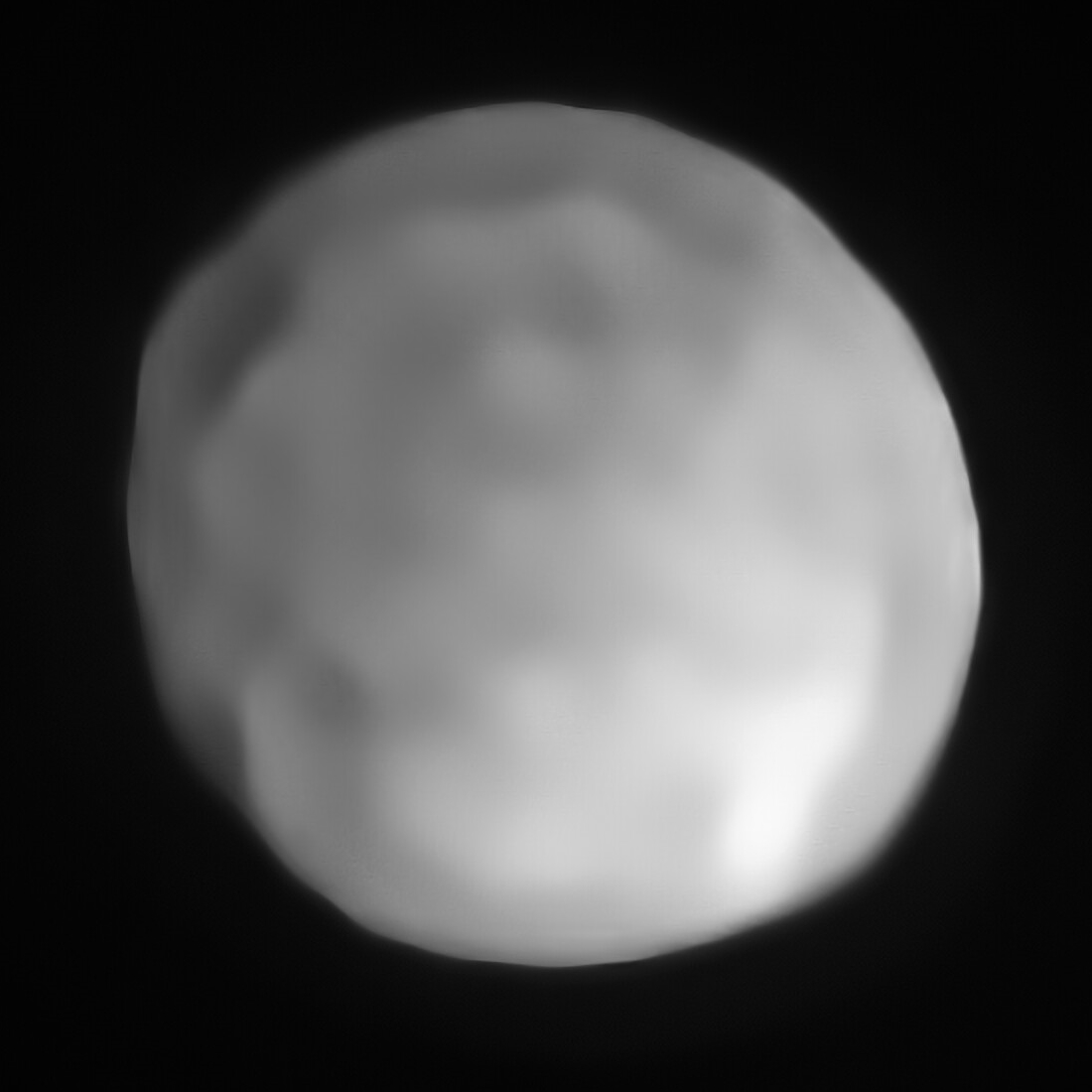
(303775) 2005 QU182 is a large trans-Neptunian object in the scattered disk, estimated to be around 440 to 740 kilometres (270 to 460 miles) in diameter. It was discovered on 30 August 2005 by American astronomers Mike Brown, David Rabinowitz and Chad Trujillo at the Palomar Observatory in California. It is scheduled for observation with the Hubble Space Telescope in 2026; if those observations discover a moon, they could lead to a measurement of the mass and density of 2005 QU182.
Distance
2005 QU182 came to perihelion in 1971 and is currently 51.8 AU from the Sun. In April 2013, it moved beyond 50 AU from the Sun. As of 2025, it has been observed 583 times over 24 oppositions, with precovery images back to 1974.
Physical characteristics
Size, brightness and albedo
2005 QU182 has a bright absolute magnitude of 3.74. In 2012, the diameter of 2005 QU182 was initially estimated to be 416±73 km using data from the Herschel Space Telescope. Later in 2020, the data was reanalyzed, which yielded a notably larger nominal diameter and uncertainty of 584+155−144 km.
Density theory
Based on its size of 584+155−144 km, it belongs to the proposed class of "mid-sized" TNOs between 400 and 1,000 km (250 and 620 mi) in diameter, which are believed to represent the transition between small, low-density TNOs and large, high-density dwarf planets. Planetary scientists have hypothesized that mid-sized TNOs should have highly porous and unheated interiors, because TNOs in this size range (such as Uni and Gǃkúnǁʼhòmdímà) have been found to have low densities around 1 g/cm3. However, 2005 QU182 is not known to have any natural satellites or moons, which means there is currently no way to measure its mass and density.
(303775) 2005 QU182 at the JPL Small-Body Database
Demo article adapted from (303775) 2005 QU182 on Wikipedia. Wikipedia text is available under the Creative Commons Attribution-ShareAlike 4.0 License; additional terms may apply.